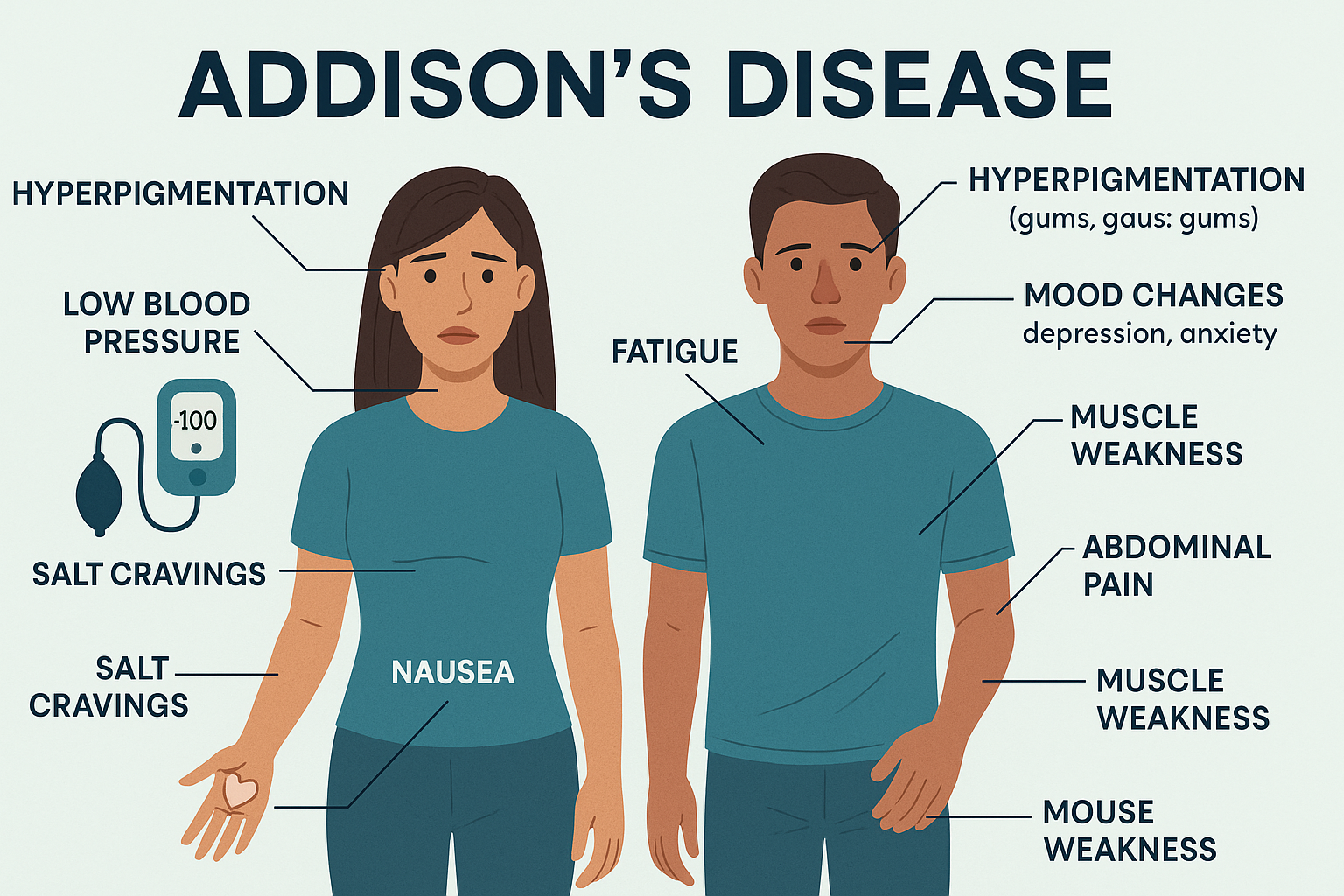
Addison’s Disease in a 40-Year-Old Man: Warning Signs
Although Addison’s disease is slightly more common in women, it can absolutely affect men—often going undiagnosed for far too long. A 40-year-old male may experience many of the classic symptoms of adrenal insufficiency such as chronic fatigue, weight loss, gastrointestinal issues, and skin changes. However, there are certain signs that may look slightly different or be easier to overlook in men. Here’s what to watch for:
🔹 Hyperpigmentation and Skin Clues
Men with Addison’s may notice their skin becoming darker, especially in areas not typically exposed to sunlight. A 40-year-old man might assume a bronze tone is from outdoor activity, but if scars, pressure points (like belt lines or shoulders from bag straps), or gums are darkening, it could signal a problem. Friends may even say he “looks tan” or “healthy” — but in this context, it’s a warning sign. Subtle dark freckles or pigmentation changes on the face, especially visible while shaving or brushing teeth, should also raise red flags
Source – NIDDK.
🔹 Changes in Strength and Physical Performance
A formerly active man may find he’s losing strength, struggling with workouts, or recovering more slowly from physical activity. Difficulty with everyday tasks like climbing stairs or standing from a seated position may develop quickly. This type of progressive muscle weakness often gets blamed on “getting older” — but with Addison’s, it’s much more abrupt and debilitating
Source – AAFP.
🔹 Libido and Hormonal Balance
Men with Addison’s can experience a reduction in libido, mood, and overall vitality. However, unlike women, men still produce testosterone via the testes, so they may not experience the same extent of hair thinning or sexual dysfunction initially. This makes Addison’s a bit trickier to spot in males, since some of the hormonal clues are less visible. If the patient also has low testosterone from another cause, the combination can lead to significant fatigue and sexual health issues — but the root problem may still be cortisol deficiency.

🔹 Blood Pressure Drops and Salt Cravings
Orthostatic hypotension — feeling dizzy or lightheaded when standing — is common in Addison’s and might be brushed off as dehydration. But in a healthy man with normal blood pressure, a sudden drop (e.g., 130/80 down to 90/60) is abnormal and should prompt a deeper look.
Men may not mention salt cravings, but drinking pickle juice, craving salty snacks, or over-salting food could be subconscious compensation for low sodium.
Source – NIDDK.
🔹 Motivation and Mental Health Shifts
It’s common for men to underreport symptoms like low mood, irritability, or apathy, but these can be early indicators of Addison’s disease. A man in his 40s may seem less engaged, more withdrawn, or frustrated — changes that might be chalked up to stress or a mid-life slump. When these emotional changes happen alongside fatigue, weight loss, or GI symptoms, Addison’s should be considered.
🔹 Warning Signs of a Developing Crisis
Men may try to “tough out” the early stages of an adrenal crisis, which can be dangerous. Symptoms like vomiting, faintness, abdominal pain, weakness, or mental confusion require immediate medical attention.
A crisis can also cause severe lower back or leg pain, sometimes described as unbearable. Combined with low blood pressure, this can cause a man to collapse suddenly.
Source – Cleveland Clinic
✅ Final Thoughts
A 40-year-old man with Addison’s disease may experience classic symptoms — darkening skin, fatigue, digestive problems, weight loss, dizziness — but might not recognize them as a pattern. If these signs are present, he should seek a full hormonal evaluation and specifically mention the possibility of adrenal insufficiency. Early detection can prevent an Addisonian crisis and may even save a life.
Source – AAFP
